Jacob Edenhofer†
University of Oxford
Maurice Hirt‡
University of Oxford
Federica Genovese§
University of Oxford
27th October 2026
Forthcoming in the Oxford Review of Economic Policy
Word count: 8,827, excluding references. Abstract: 150 words.
Abstract
Rich democracies have cut emissions considerably but unevenly across countries and sectors. Yet, their policies remain short of what net zero requires. We examine this uneven progress by distinguishing adopted from durable stringency and linking electoral and producer politics through policy credibility. Adopted policy, we argue, endures only if the vote-seeking incentives or policyseeking motives behind it last long enough for firms to adjust, while voters’ costs remain contained. Depending on whether they persist, recur, or reverse, three trajectories emerge. Under latent electoral demand, persistent policyseeking motives yield quiet accumulation of modest, largely durable increases. Recurrent clear activation produces punctuated accumulation of larger but only partly durable increases. Policy cycling occurs in polarised electorates, where government turnover deters firm adjustment. These trajectories help clarify when prominent accounts of climate policymaking hold, show how its obstacles differ across contexts, and explain why the road to net zero will likely be noisy.
*We thank Christian Flachsland, David Rueda, Ottmar Edenhofer, Michael Pahle, participants in the special issue workshop, especially the editors Sam Fankhauser and Johanna Arlinghaus, and two reviewers for valuable comments. All remaining mistakes are naturally our own. Claude and ChatGPT were used solely for text-editing purposes.
†Nuffield College & DPIR. Email: jacob.edenhofer@nuffield.ox.ac.uk. Corresponding author.
‡University College & DPIR. Email: maurice.hirt@politics.ox.ac.uk.
§ St. Antony’s College & DPIR. Email: federica.genovese@politics.ox.ac.uk.
1 Introduction
Since around 1990, many rich industrialised democracies1 have substantially reduced their emissions (IPCC, 2022). Nevertheless, existing policies, even if fully implemented, fall well short of net-zero commitments (UNEP, 2026). This tension reflects the uneven progress across countries and sectors, with emissions reductions concentrated mainly in electricity generation and slower progress in others, such as transport and buildings. Though politically appealing in the past, this sectorally bounded approach to climate mitigation is increasingly at odds with the demands of net-zero targets. These require deep reductions across almost all sectors by the target date—often only about two decades away (Hale et al., 2022)—and the balancing of residual emissions and removals (Fankhauser et al., 2022; Dolphin et al., 2023). Understanding the politics of net zero therefore requires explaining the political logic of uneven progress to date.
To this end, we draw on the comparative climate politics literature, whose three dominant strands direct attention to the electoral incentives of governments, the interests and power of producers, and the institutions mediating or moderating their interaction. The first examines the determinants of preferences for climate policy and, to a lesser extent, their relevance for political behaviour and policymaking (Schaffer et al., 2022; Dechezleprêtre et al., 2025). The second investigates how conflict between clean and carbon-intensive firms, and among carbon-intensive ones, affects policy choices (Meckling, 2011, 2015; Kelsey, 2018). The third analyses the institutional sources of policy credibility and the effects of policy feedback on the interests of producers and voters (Finnegan, 2022; Lockwood, 2021b, 2022). What remains unclear, however, is how electoral incentives and producer interests interact over time to determine how much of an adopted change in stringency becomes durable.
The dependent variable of our conceptual framework is accordingly the durable level of stringency—the level of policy ambition (Nachtigall et al., 2024)—that is preserved following adoption once its costs have begun to materialise for voters and producers. We refer to the difference between the adopted and the durable level as the adoption–durability gap. This gap matters practically because only durable increases in stringency provide sustained incentives for reducing emissions in the long run, and analytically because adoption and durability follow related but
1Analysing climate politics in other democracies or non-democracies is beyond our scope.
distinct political logics.
To elucidate these logics, we use the policy episode in a country and sector as our unit of analysis and trace episodes over time via policy trajectories, defined as sequences of policy episodes. Three building blocks characterise each episode. First, electoral demand depends on climate policy’s salience and the distribution of voters’ preferences. Under latent demand, low salience leaves only policy-seeking motives for action, though attributable costs still provoke opposition. Under clear activation, high salience and tightly clustered preferences create clear vote-seeking incentives to raise or lower stringency. Under noisy activation, salience penalises inaction while dispersed preferences leave the direction of change undetermined from a vote-seeking perspective (Busemeyer et al., 2020), making policy dependent on policy-seeking motives (Lindvall et al., 2023). Second, the producer environment comprises the relative political power of clean and carbon-intensive firms, with the latter deciding whether to resist climate policy or adjust. Firms facing lower adjustment costs may adjust, partly to increase market share (Kennard, 2020), potentially dividing the “dirty” bloc (Drahos, 2025).
Third, policy credibility—the expectation that policy will persist long enough for investment and behavioural change to pay off (Brunner et al., 2012; Gazmararian and Tingley, 2023)—links the electoral and producer sides. Producers adjust only with that expectation, which electoral demand informs by signalling whether proclimate incentives will persist or recur. Consequently, credibility has two sources. The first is exogenous to current adjustment, reflecting, among other factors, political institutions (Finnegan et al., 2026). The second is endogenous, arising from policy feedback as adjustment gives producers (and voters) an interest in continued stringency. Separating these sources of credibility avoids circularity. Initial adjustment reflects the exogenous baseline level of credibility; the policy feedback this adjustment generates then changes the baseline, which the next episode inherits.
The central argument that emerges is that durable stringency depends on whether pro-climate electoral or policy-seeking incentives persist long or recur often enough to induce producer adjustment and whether policy design can contain the associated costs for voters. Depending on whether these incentives persist, recur, or reverse, three stylised trajectories illustrate how the interplay between voters and producers affects the scale and frequency of adopted increases and their adoption– durability gaps. Persistent policy-seeking motives under latent electoral demand can support quiet accumulation, where credible policy induces producer adjustment
and frequent, modest increases are thus largely retained. Recurrent episodes of clear electoral demand can produce punctuated accumulation, with fewer, larger increases that are adopted despite producer opposition and whose durability depends on whether producers adjust before salience recedes. Polarised electorates can result in policy cycling, with the risk of reversal discouraging producer adjustment and making it harder to lock in progress. Analysing these trajectories yields both analytical and practical payoffs. Analytically, they specify the scope conditions of some of the most prominent accounts of climate politics. Practically, they clarify the current debate about the “climate backlash” (Colgan and Genovese, 2025; Bosetti et al., 2025). As costs become harder to diffuse and firms’ adjustment harder to induce, the road to net zero will likely be noisier and more conflictual, with obstacles to further decarbonisation that differ across countries.
The remainder of this article is structured as follows. Section 2 develops the analytical building blocks. Section 3 derives and illustrates the three trajectories, and Section 4 derives lessons about the political logic of past progress and the future politics of net zero.
2 Analytical building blocks
Democratic policymakers navigate pressure from both voters and organised producers. They depend on voters to win office, and on producers’ information, resources, investments, and cooperation to fund campaigns and enact policy (Hall, 2026).2 Three characteristics of climate mitigation make this interaction especially consequential. First, it is perhaps the quintessential long-term policymaking problem, requiring policymakers to impose present costs for uncertain future benefits (Jacobs, 2011; Lindvall, 2017; Hale, 2024). This creates a potential mismatch between myopic electoral incentives and the time required for investments in mitigation to pay off. Second, climate’s electoral salience is intermittent, in that climate rarely structures political competition for sustained periods despite mattering to a nontrivial share of voters (Schaffer et al., 2022). Third, phasing out carbon-intensive production can strand “dirty” assets on a large scale, making the material stakes high, if not existential, for many producers (van der Ploeg, 2016; Colgan et al., 2021). The analytical challenge is to explain when electoral impulses induce more strin-
2This section builds on Edenhofer (2027).
gent policy that producer adjustment then sustains, and when producer opposition dilutes policy as those impulses fade.
Addressing this challenge requires a dependent variable that captures declines in effective stringency even when policies remain formally in place. We therefore define durable stringency as the part of an adopted change that endures once its net costs have materialised or come to be expected, and governments have had an opportunity to revise it (Patashnik, 2008).3 The adoption–durability gap summarises how much of an adopted change is undone. It arises when later policies counteract existing ones or when policymakers dilute them, for instance through exemptions or cuts to enforcement budgets.4 Dilution can follow government turnover or the adopting government’s reassessment of the political costs involved. Our unit of analysis is the policy episode in a country and sector.5 Episodes begin with an adopted change in stringency and encompass the political responses that determine how much is retained. Policy trajectories, which are sequences of episodes, summarise the direction, scale, frequency and durability of adopted changes in a sector, and how earlier episodes affect later ones through inherited policies, producer adjustment and policy credibility.6
2.1 Electoral demand
On the electoral side, the framework’s explanatory variable is the state of electoral demand. Taking voters’ climate preferences and their determinants as given,7 we examine when those preferences matter for the policymaker’s electoral calculus. We assume policymakers pursue policy-seeking objectives under a (re-)election constraint (Strøm, 1990). Their latitude to do so varies with the salience and clarity of electoral incentives. Salience is understood as the importance voters attach to climate policy relative to other political issues (Culpepper, 2011, p. 4). The clarity of
3These conditions specify a minimum horizon for evaluating durability; empirically identifying them is a challenge for future research.
4We set aside bureaucratic implementation frictions.
5The country-sector is an analytically useful compromise. Sectors share a national electorate but differ in producers’ relative power and adjustment costs; examining whole countries would obscure these differences, while analysing individual policies would obscure their combined effects on producer adjustment.
6Cross-sectoral policies can contribute to several trajectories.
7We assume only that demand for climate policy declines as voters’ material costs increase, consistent with evidence that support for climate policy is broad (Andre et al., 2024) but highly costsensitive (Gaikwad et al., 2022; Dechezleprêtre et al., 2025; Armbruster et al., 2027).
the electoral signal describes whether—once climate policy is salient—the distribution of preferences gives the policymaker an identifiable vote-maximising direction (Busemeyer et al., 2020; Lindvall et al., 2023).8 The interaction between salience and clarity generates three types of electoral demand: latent demand, clear activation, and noisy activation.
Latent demand. Electoral demand is latent when voters’ preferences over climate policy do not structure political competition because other issues, say immigration, are more salient. Latency reflects voters’ limited attention (Key, 1961). Voters can consequently support climate action whilst failing to reward governments for it when other issues are more pressing. Under latent demand, policymakers face asymmetric electoral incentives. Voters are less likely to punish climate inaction than action, especially when the action entails costs, such as higher bills or lost jobs, which are easily attributable to policy decisions (Arnold, 1990; Mildenberger and Sahn, 2025). The risk of imposing material losses for an objective voters accord low priority induces electoral caution, even among policymakers who favour greater stringency for non-electoral reasons.
Increasing stringency under latent demand requires two conditions. First, policymakers must have sufficiently strong policy-seeking motives for climate action. These can derive from core voters’ preferences, personal convictions, or the presence of pro-climate bureaucrats. Second, they must be able to limit voters’ exposure to costs, notably by diffusing these geographically (e.g. shielding marginal constituencies) or temporally (e.g. funding subsidies via future tax increases). Even then, policymakers will prefer a sequence of gradual increases—whose moderate costs can be diffused relatively easily—over large increases, whose costs are harder to diffuse and electorally riskier.
Clear activation. Clear activation—salient climate policy combined with sufficiently tightly clustered preferences—yields electoral signals pointing in an identifiable direction to increase or decrease climate ambition. Climate can become salient (“activated”) by exogenous shocks, like natural disasters (Hilbig and Riaz, 2024) and energy price spikes (Konc et al., 2026), or endogenously via mobilisation by parties, protests (Brehm and Gruhl, 2024; Barrie et al., 2024), corporate scandals
8This need not be determined by the “median” voter. Under plurality rule in single-member districts, pivotal voters in marginal constituencies are often decisive (McGillivray, 2004).
(Culpepper et al., 2026), or interest groups’ attempts to influence public debate (see Section 2.2 on outside lobbying).
Either way, this is the canonical case of electoral responsiveness (Schaffer et al., 2022). High salience makes inaction electorally costly when voters favour change; clarity means policymakers can confidently expect electoral rewards for moving in the signal’s direction. Indeed, when voters favour greater stringency, these incentives can support larger increases than latent demand usually allows.
Noisy activation. Activation is noisy when climate is salient but the aggregate electoral signal is unclear, or “loud but noisy” (Busemeyer et al., 2020). This uncertainty can stem from exogenous increases in salience exposing widely dispersed preferences over stringency or polarised groups demanding opposing changes; or policymakers’ uncertainty about the extent to which voters’ current preferences price in the future costs of a policy.9 Competing interest groups can compound this by raising climate’s salience through opposing frames, with proponents typically stressing benefits and opponents costs (see Section 2.2).
Whatever their source, noisy signals place policymakers under greater pressure to address climate policy than under latency, yet provide less electoral guidance than clear activation. Core constituencies thus acquire greater influence through two mechanisms. Where satisfying one group alienates another, parties often focus on mobilising their own constituencies (Aldrich, 1983), rather than attracting swing voters. Where the broader electorate’s preferences are uncertain, following core voters also becomes more attractive given that there is less uncertainty about their preferences (Lindvall et al., 2023).
The limits of electoral demand. Overall, electoral demand leaves room for action driven by policy-seeking motives under latency, gives policymakers an identifiable vote-maximising direction under clear activation, and increases core constituencies’ influence under noisy activation. This helps explain differences in adopted stringency, yet our dependent variable is durable stringency. Because climate salience is intermittent, the electoral conditions permitting adoption may not favour retention, particularly as costs crystallise. We next turn to producers, whose adjustment can
9Surveys can only partly resolve this uncertainty because, until a policy’s costs become salient, responses mainly reflect salient considerations related to its benefits (Zaller, 1992).
create material interests in continued stringency that outlast those electoral conditions.
2.2 The producer environment
We divide producers—firms and the organisations through which they seek political influence, such as business associations—into two broad categories (Meckling, 2011; Kalkuhl et al., 2020). Dirty producers rely on carbon-intensive technologies, whereas clean producers provide substitutes like renewable electricity or electric vehicles. Climate policy generally benefits clean producers, by, among other things, expanding their markets and boosting “green” demand (Besley and Persson, 2023). Dirty firms face compliance costs and asset devaluation that can threaten their commercial viability.
For each policy episode, we focus on dirty producers whose adjustment or resistance shapes how much adopted stringency becomes durable. Clean producers, including those in other sectors, matter in two ways. First, their technologies can persuade policymakers that mitigation offers economic and geopolitical opportunities (e.g. energy security), bolstering policy-seeking motives under latent demand (Section 2.1). Second, their political power vis-à-vis dirty producers tends to grow as durable stringency increases.
Adjustment and resistance. Given their preferences, we conceive of dirty producers as choosing between adjustment and resistance.10 Adjustment means making irreversible investments that reduce a producer’s dependence on carbon-intensive production. Resistance describes political action to block, delay, dilute, or reverse policy. The expected returns determine the adjustment–resistance choice. Two characteristics are particularly important: the distribution of adjustment costs among dirty producers and the relative political power of clean and dirty producers. Adjustment is more attractive when low-carbon substitutes become commercially viable and less attractive when assets, skills, or organisational structures are tailored to carbon-intensive production (Breetz et al., 2018; Kelsey, 2018; Fischer, 2026). Because adjustment is irreversible and its returns accrue over time, firms’ expectations
10We treat firms as unitary actors, abstracting from work on ownership and board composition (Lerner and Osgood, 2023; Finnegan and Meckling, 2026), and intermediate strategies such as hedging and diversification (Meckling, 2015; Green et al., 2022).
of policy persistence also matter (Section 2.3).
At the sectoral level, the interest group posture reflects the balance between coordination and competition among firms. Sectoral resistance requires coordination, which business associations can facilitate even when firms face different adjustment costs, while supply-chain linkages can align interests across firms (Cory et al., 2021; Jensen, 2025; Toenshoff, 2027). Competition can fracture resistance when differences in adjustment costs are sufficiently large. Firms that can adjust more cheaply may support greater stringency when it raises rivals’ costs more than their own (Kennard, 2020; Drahos, 2025). Whether such divisions alter policy depends on the relative political power of the resulting producer groups.
Relative power. Producer power can be structural or instrumental (Culpepper, 2025). Structural power derives from producers’ economic importance, typically their share of value added or employment (Lindblom, 1977). Policies imposing large losses on structurally powerful producers can induce costly responses, including reduced investment (Przeworski and Wallerstein, 1988) or relocation (Bayer, 2023). Anticipating these consequences, policymakers may accommodate their interests even without lobbying.
Where structural power is insufficient to induce anticipatory accommodation, producers lobby. The effectiveness of lobbying depends on their instrumental power the capacity to influence policy through political action. Inside lobbying targets policymakers, notably via technical information (Culpepper, 2011) or haggling over arcane policy details, as with free allowances in emissions trading systems (Sato et al., 2022). Outside lobbying targets voters to influence policymakers indirectly by mobilising affected constituencies or changing perceptions of public opinion (Kollman, 1998). Dirty producers often emphasise costs, employment, or regional economies (Stokes, 2020).
The relative value of these strategies partly depends on electoral demand (Section 2.1). Under latency, inside lobbying is especially valuable because public scrutiny is limited (Culpepper, 2011). Under noisy activation, outside lobbying can redirect electoral pressure by increasing the salience of policy costs. Under clear activation, producers’ ability to distort the electoral signal is limited, with inside lobbying emerging as the main strategy.
Relative power changes as dirty firms adjust and clean producers gain economic and political resources. Yet policy can also preserve incumbent rents or subsidise firms without inducing adjustment (Møller, 2024). We focus on episodes in which dirty producers initially hold a substantial power advantage over clean producers (Brulle and Downie, 2022)—strong enough to constrain policy but not so overwhelming that clean producers are politically irrelevant.
Policy feedback. Once dirty producers adjust, weakening stringency would devalue their investments, giving them reason to defend existing policy (Pierson, 1993; Pahle et al., 2018; Trachtman, 2023). Adjustment does not, however, imply support for further increases. Further increases may require new investments that firms adjusted to the current level have not made, and may erode the advantage early adjusters enjoy over laggards and entrants (Kennard, 2020; Dugoua and Moscona, 2026). Where adjustment was induced by subsidies or concessions, adjusted producers’ returns often depend on their continuation, giving them reason to resist changes that reduce their rents (Møller, 2024). And transitional assets, such as gas plants that replaced coal, are themselves threatened by deeper decarbonisation (van der Ploeg, 2016). Policy-induced adjustment thus makes reversals harder without necessarily generating self-reinforcing support for ever more stringent policy. The political battle over new increases will have to be fought anew. Whether producers will adjust crucially depends on their expectation of durable stringency.
2.3 Policy credibility
Policy credibility is the expectation that policy will persist long enough for investment and behavioural change to pay off (Brunner et al., 2012; Dolphin et al., 2023; Gazmararian and Tingley, 2023). It matters because the long-term nature of climate mitigation (Section 2) creates a commitment problem. Governments may favour adjustment ex ante yet weaken policy ex post as electoral incentives, fiscal pressures, or the salience of costs change. Given irreversible investment, the resulting uncertainty raises the option value of waiting, leading producers to delay otherwise profitable adjustment (Fabrizio, 2013; Basaglia et al., 2025a; Dolls et al., 2026).
Because climate’s electoral salience is intermittent, stringency persists mainly where it has induced adjustment, which in turn requires that producers expect it to persist. Credibility is therefore the hinge between the electoral and producer sides. Electoral demand affects producers’ expectations directly, when they infer future governments’ incentives from electoral signals, and indirectly, when policymakers respond to electoral uncertainty by delaying or diluting policy.11 The producer environment affects them through relative power. Dirty producers able to secure dilution give all producers reason to discount stringency, unless large differences in adjustment costs make the dirty bloc likely to fracture (Section 2.2). Powerful clean producers have the opposite effect. Empirical evidence on these channels is scarce, a gap future research should address.
Credibility has a baseline component, exogenous to producer adjustment in the current episode, and an endogenous component. Beyond electoral demand and the producer environment, political institutions are one prominent baseline source, affecting how easily future governments can revise policy (Finnegan, 2022; Finnegan et al., 2026).12 We remain agnostic about the determinants of baseline credibility, assuming only that some such baseline exists independently of current adjustment.
The endogenous component arises through policy feedback. As firms adjust, sunk assets and supply chains become dependent on continued stringency, raising the political costs of weakening policy (Pierson, 1993; Stokes, 2020). Adjustment can also generate electoral feedback where new employment or local investment gives affected constituencies an interest in continuation (Alberdi, 2024), though this—akin to successful climate compensation (Edenhofer and Genovese, 2024; Arel-Bundock and Pelc, 2026)—requires the benefits to be clearly attributable to policy decisions and credible (Gazmararian et al., 2026). Feedback can strengthen credibility only after some producers have adjusted, yet adjustment itself requires credibility. Distinguishing baseline from endogenous credibility avoids this circularity. Initial adjustment draws on baseline credibility; the feedback it generates then becomes part of the baseline inherited by later episodes.
11There is, to our knowledge, no empirical evidence regarding the link between the electoral environment and producers’ expectations about policy credibility. Theoretically, we would expect that clear activation favouring stringency may raise credibility if producers expect the signal to persist or recur, whereas noisy activation may lower it by creating uncertainty about future electoral incentives.
12A less clear-cut source is technological change. Some technological changes—albeit by no means all, as work on policy-induced technological change reminds us (Calel and Dechezleprêtre, 2016; Nemet, 2026)—are independent of policy. Where they lower adjustment costs, they reduce the degree of policy persistence producers need to expect before adjusting at a given level of stringency.
2.4 Strategic interaction and durable stringency
Figure 1 summarises how the building blocks combine in a policy episode. Policymakers adopt a change in stringency given their policy-seeking motives, electoral incentives, and the producer environment (Sections 2.1 and 2.2). The adopted policy generates a distribution of costs and benefits across voters and producers. Under latent demand, policymakers seek to shield voters from these costs by avoiding large increases in stringency or by obscuring costs through policy design. Dirty producers then adjust or resist, depending on their adjustment costs and policy credibility (Section 2.3). Once net costs materialise, the government, or its successor, maintains or dilutes the change, which determines durable stringency. The commitment problem (Section 2.3) arises because policymakers cannot bind themselves or their successors at adoption.
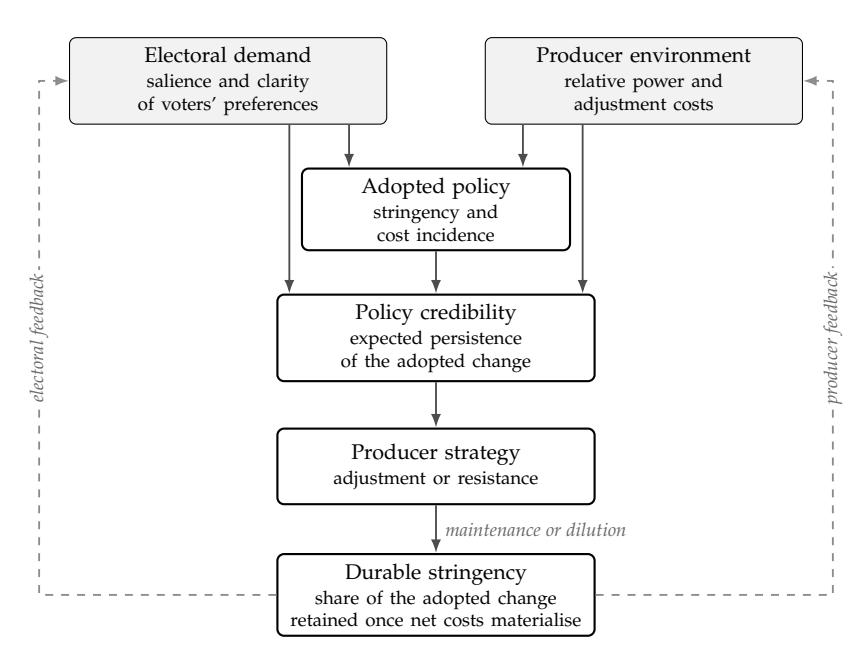
Figure 1: Strategic interaction in a policy episode.
Note: Grey boxes denote conditions determined prior to the episode; white boxes denote quantities determined during the episode. Solid arrows indicate the sequence of decisions, each taken in anticipation of later ones. Dashed arrows indicate feedback. The direct arrows from electoral demand and the producer environment to credibility indicate that producers infer future governments’ vote-seeking incentives from electoral signals and discount stringency that powerful dirty producers can dilute.
Adoption and durability follow related but distinct political logics because the vote-seeking incentives or policy-seeking motives behind an adopted change often fade before producers adjust. This temporal mismatch tends to grow with the scale of the change, which requires more adjustment and imposes larger costs. It is largest under clear activation, which can support large increases but is typically transient, whereas their costs remain visible to voters (Section 2.1). It is smallest under latent demand, where persistent policy-seeking motives can sustain modest increases while producers adjust. A change is retained if vote-seeking incentives or policy-seeking motives still favour it once net costs materialise, or if adjustment has given dirty producers a stake in it. The adoption–durability gap is then the part of an adopted change that rested on vote-seeking incentives or policy-seeking motives which faded or reversed before producers adjusted. Conversely, durable stringency requires them to persist or recur, and cost incidence to limit voters’ exposure, long enough for credible policy (Section 2.3) to induce adjustment. This answers the challenge posed at the outset of Section 2.
3 Trajectories towards (non-)durable stringency
Using the logic of a single episode developed in the preceding section, we next examine how trajectories—sequences of episodes in a country-sector—lead to the accumulation of durable stringency or fail to do so. The analysis of a single episode takes the conditions it inherits, such as baseline credibility and the producer environment, as given. In a trajectory, these conditions result from earlier episodes. Trajectories therefore allow us to illustrate how retaining or diluting one change in stringency influences the prospects of adopting and retaining another in the next episode, and hence whether durable stringency accumulates.
As retention hinges on whether the incentives driving adoption last until producers adjust (Section 2.4), trajectories differ in the source and temporal pattern of pro-climate incentives—whether vote-seeking incentives or policy-seeking motives drive adoption and whether these persist, recur, or reverse across episodes. Figure 2 visualises the three trajectories we deem empirically most relevant.13 In quiet accumulation, persistent policy-seeking motives under latent demand produce frequent, small, and largely retained increases. In punctuated accumulation, recurrent clear pro-climate activation produces fewer, larger, and only partially durable increases. In policy cycling, alternating governments with divergent motives under noisy activation produce increases followed by reversals (or vice versa).
13These three trajectories do not exhaust the space of logically possible combinations.
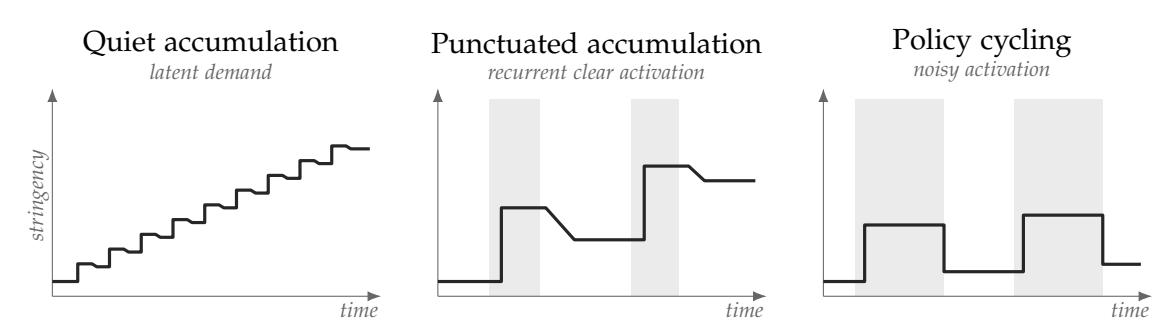
Figure 2: Stylised policy trajectories in a country and sector.
Note: Upward steps represent adopted increases; subsequent declines represent dilution. Shading indicates clear pro-climate activation (centre) and pro-climate governments (right). The upward drift under policy cycling assumes that pro-climate episodes induce some adjustment.
We next illustrate each trajectory with a case from electricity, the sector in which decarbonisation has advanced furthest (Section 1). Holding the sector constant means that differences between the cases are more likely to reflect differences in trajectories than differences in sectoral conditions. Readers who disagree with our classification may still find the logic useful.
3.1 Quiet accumulation
Quiet accumulation is characterised by frequent, modest increases under persistently latent electoral demand, most of which are retained (left panel, Figure 2). Given that voters punish costly action more readily than inaction, vote-seeking incentives counsel caution (Section 2.1). Action therefore depends, if at all, on policy-seeking motives. These motives must persist across governments—both for adopted increases to be maintained (Section 2.4) and for further ones to be adopted. Among the sources of such motives (Section 2.1), policy-motivated bureaucrats are particularly persistent because—unlike ministers—they often remain in post across electoral cycles.14
Yet, policy-seeking motives engender action only if policymakers can also limit voters’ exposure to costs (Section 2.1). They do so through policy design, diffusing costs, for instance through levies on energy bills or deferred tax increases (Section 2.4). Obscure costs keep demand latent, protecting the “motor” of quiet accumulation. For if costs became visible, ministers’ vote-seeking incentives would
14Bureaucrats’ pro-climate policy motives can reflect selection into climate-focused ministries or learning on the job (Gailmard and Patty, 2012; Gratton and Lee, 2026; Clark and Zucker, 2024).
likely propel them to clip officials’ wings.15 Policymakers therefore prefer modest increases, whose costs are easier to diffuse and which require less producer adjustment.
Adjustment, in turn, requires credibility. With latent demand offering little guidance about future electoral incentives, credibility derives mainly from persistent policy-seeking motives. Dirty producers with high adjustment costs, meanwhile, use inside lobbying to parlay their relative power into concessions such as free allocation. In response, governments can divide the dirty bloc by compensating only the most powerful producers (Meckling and Nahm, 2022). As low-cost firms adjust and clean producers expand, feedback raises baseline credibility for the next increase (Section 2.3). This keeps adoption–durability gaps small.
Potent though it may be, quiet accumulation has limits. First, as low-cost producers adjust, each further increase requires adjustment by higher-cost firms and thus larger inducements, which tight budgets constrain. Adjusted producers, meanwhile, lobby little for further increases, which may require new investments or erode their advantages (Section 2.2). Second, where costs cannot be easily hidden as in the buildings and transport sectors—vote-seeking incentives make policymakers reluctant to ramp up ambition (Section 2.1). Either way, stagnation, the trajectory’s characteristic failure, can ensue, with earlier increases being retained but no new ones being adopted.
British electricity between about 2008 and 2024 approximates quiet accumulation. Electoral demand was mostly latent, with climate rarely ranking among the most important issues (Kenny, 2024). Policy-seeking motives originated with elite actors, whose initiatives—notably Friends of the Earth’s campaign and the Treasury-commissioned Stern Review of costs and benefits of climate action—paved the way for the 2008 Climate Change Act (Carter and Childs, 2018; Lockwood, 2013). These motives persisted because officials at the Treasury and the Climate Change Committee, established by the Act, outlasted frequently changing ministers (Lockwood, 2021a; Zwar et al., 2026). Successive governments accepted the Committee’s proposed medium-term emission targets (“carbon budgets”), bolstering the Act’s credibility (Lockwood, 2021b). Levies on electricity bills funded support for renew-
15Delegation to bureaucrats can counter electoral myopia and help provide the public good of mitigation. Where provision depends on hidden costs, however, it risks technocratic drift, with electorally unaccountable officials locking in policies that many voters would reject if they understood the costs (Gratton and Edenhofer, 2025).
able generators, obscuring the costs for voters. This support helped utilities adjust, closing coal plants and investing in renewables (Kattirtzi et al., 2021). Compensation kept other potential losers, such as owners of fossil-fuel plants and energyintensive manufacturers, quiet (Basaglia et al., 2025b). Despite these concessions, the last coal-fired power station closed in 2024.16 Yet policy in transport and buildings, where costs borne directly by households proved hard to diffuse, stagnated over the same period.
3.2 Punctuated accumulation
The term “punctuated accumulation” borrows from work on the evolution of policy agendas (Baumgartner and Jones, 2009). In our framework, this is characterised by infrequent, large increases, only some of which are retained (middle panel, Figure 2). This pattern reflects occasional electoral windows—triggered by exogenous shocks or mobilisation—for ambitious climate action followed by periods of latent demand in which some producers adjust while others lobby to dilute the adopted policy. Clear activation, combining high salience with tightly clustered preferences, gives policymakers strong vote-seeking incentives to raise ambition further than latent demand allows (Section 2.1). This also reduces the pressure to diffuse costs that materialise during the window, though those that materialise after still pose electoral risks. As salience declines, so does the potency of vote-seeking incentives; and policy-seeking motives are too weak to sustain quiet accumulation. Further increases therefore require renewed activation.17
Whether increases endure then depends largely on the balance of power between producers that adjust and those that lobby. Adjustment, in turn, requires credibility that outlasts activation (Section 2.3). It can derive from the expected recurrence of activation, or from legislation and institutions created during the window, such as independent climate advisory bodies, that raise the cost of dilution (Zwar et al., 2026).18 With voters’ preferences tightly clustered, dirty producers can do little via outside lobbying and rely on inside access instead, seeking exemptions during the
16Climate policy was not the only driver. The 1980s pit closures and the “dash for gas” during the 1990s also mattered.
17This assumes that the distribution of voters’ preferences changes slowly relative to the time between episodes of activation.
18Proposals for “insulation” of this type often assume that the political environment never changes enough to make abolition worthwhile, which is plausible for modest changes but not for large ones.
window and dilution after it (Section 2.2). How much policymakers acquiesce depends on their expectations about dirty producers’ power, their adjustment, and the probability that clear activation will recur soon enough. Where policymakers expect recurrence, or enough producers have adjusted, much of the increase is retained. Otherwise, much of it is diluted once salience recedes, leaving a large adoption– durability gap (Section 2.4).
The characteristic failure of punctuated accumulation is dissipation, in which much of the adopted change is diluted before activation recurs. Dissipation can engender scarring effects, with producers who witnessed dilution discounting subsequent increases. Later activation then induces less adjustment and lends policy less credibility. By the same token, if the costs of an increase materialise while (most of) its benefits do not, voter preferences that were tightly clustered during the window may disperse. Later activation is then more likely to be noisy.
German electricity since the late 1990s bears out this logic. Germany’s Greens, an electoral force since the 1980s (Arend et al., 2025), entered government in 1998 and helped introduce the 2000 Renewable Energy Sources Act, whose feed-in tariffs, funded by an inconspicuous levy on electricity bills, gave investors a stake in their expansion (Edenhofer and Flachsland, 2025). As demand remained mostly latent through the 2000s and early 2010s, however, much of the impulse beyond these tariffs dissipated.19 New coal plants came online, and in 2015 coal operators defeated a levy on older plants, securing payments for keeping these plants in reserve instead (Pahle, 2010; Brauers et al., 2020). Clear activation in 2018–19, driven by Fridays for Future, opened a window (Brehm and Gruhl, 2024), and left incumbents little scope for outside lobbying. But their inside access in the coal commission allowed them to secure a late—relative to market conditions (Pahle et al., 2019)—phase-out date, 2038, and generous compensation. The latter bought operators’ acquiescence and made exit credible (Meckling and Nahm, 2022). The window also yielded a climate framework law (Flachsland and Levi, 2021; Zwar et al., 2026), while the prospect of financial penalties under the EU effort-sharing regulation and expert proposals translated electoral pressure into a national carbon price on heating and transport fuels (Edenhofer and Flachsland, 2025).20 Where households bear such costs dir-
19Officials in the environment ministry defended the feed-in tariffs under ministers from different parties.
20Member states whose emissions from transport, buildings, agriculture, waste, and small industry exceed their annual allocations must cover the shortfall, e.g. by acquiring allocations from other member states.
ectly, dissipation looms again, as the fallout from the 2022 energy price shock and the 2023 heating law shows (Bechtel et al., 2026; Konc et al., 2026).
3.3 Policy cycling
Policy cycling is characterised by increases followed by reversals (right panel, Figure 2). It arises under noisy activation, when climate is salient but dispersed or polarised preferences leave policymakers without a clearly identifiable votemaximising direction (Section 2.1). This shifts weight towards parties’ core constituencies. When preferences are polarised, a position that attracts some voters repels others, and moving towards the centre wins few swing voters while risking abstention among a party’s own supporters. Catering to the core often pays more then.21 Since core voters differ across parties on whether and how stringently to act, and on who should bear the net costs, partisan control of government becomes decisive for climate policy. Each alternation in government then reverses the direction of policy, as incoming parties undo their predecessors’ measures. Under clear activation, by contrast, the identifiable vote-maximising position induces parties to converge, and partisan control matters less.
The producer environment reinforces this partisan logic. Dirty producers tend to ally with parties whose core voters they employ or whose regions they anchor, and clean producers with those parties’ rivals (Stokes, 2020).22 Under noisy activation, dirty producers also gain from outside lobbying since emphasising costs, jobs, and regional decline mobilises the anti-climate core. Nor does compensation offer a way out. It is subject to the same commitment problem as the policy itself. Successors can repeal the policy while keeping the compensation, or scrap both.
Adjustment by producers requires credibility that outlasts a change of government. Where alternation between parties with divergent core constituencies is expected, however, the option value of waiting increases (Section 2.3). Concomitantly, producers adjust little and have weak incentives to defend climate policy, which makes reversal politically cheap. To the extent that any durable progress can hap-
21Edenhofer and Rueda (2026) conceptualise the loyalty of core voters as a stock variable. Parties harvest it by moving towards the median when the electoral gains from doing so are large, and repair it when these gains are small or when rivals close to the core threaten defection. Noisy activation weakens the median’s pull and thus favours repair.
22This alignment is tempered where carbon-intensive capital and labour are represented in parties of the centre right and left, respectively. Such double representation constrains the latter’s room for manoeuvre on climate (Mildenberger, 2020).
pen under policy cycling, it resembles a lock-in contest. Pro-climate governments seek to entrench policy before the next turnover via, for example, the delegation of climate policy to independent institutions or the use of subsidies and other benefits to create beneficiaries before the next election, while their opponents seek to prevent entrenchment by pledging repeal.23 Producers adjust only if they expect the former to prevail. Sources of baseline credibility beyond national partisan competition, such as sub-national policy or international commitments, can tip the contest, as can technological change that lowers adjustment costs (Section 2.3).
The characteristic failure of policy cycling is recurrent erosion, in which successive governments remove much of each preceding increase. It is here that classic concerns about government turnover undermining policy commitments are most compelling (Brunner et al., 2012).24 Because adjusted producers defend existing policy, erosion remains incomplete to the extent that pro-climate episodes induce adjustment, and stringency then drifts upwards across cycles (right panel, Figure 2).
Australian electricity since the mid-2000s exemplifies policy cycling. Bipartisan support for emissions trading in 2007 gave way to noisy activation after Tony Abbott won the opposition leadership in 2009 by campaigning against carbon pricing (Crowley, 2017). Carbon-intensive capital and labour had a voice in the Coalition and Labor, respectively, tempering the latter’s ambition (Mildenberger, 2020). Mining associations also lobbied voters through advertising campaigns. A minority Labor government reliant on the Greens introduced a carbon price in 2012, compensating households and emissions-intensive industries, while the opposition pledged repeal (Crowley, 2017). Elected in 2013, the Coalition won this lock-in contest, abolishing the price in 2014 while keeping most household compensation, and cutting the renewable energy target in 2015. Renewable investment fell amid the prospect of further reversals (Crowley, 2021). Labor’s return in 2022 led to the adoption of climate framework legislation (Zwar et al., 2026), while state-level policies, a further source of baseline credibility, had limited erosion throughout.
23The Biden administration’s Inflation Reduction Act (IRA) of 2022 illustrates this. Whether channelling clean investment into Republican-held districts would shield its tax credits from repeal remains hotly debated (Gazmararian et al., 2026). The 2025 reconciliation act curtailed those for wind, solar, and electric vehicles, while retaining most others for longer.
24In contexts with centripetal electoral incentives or many veto players, such concerns are typically less compelling because alternation in government then changes policy little (Cox, 1990; Lindvall, 2017).
4 Lessons and outlook
The trajectories developed above reveal the political logic of progress in climate policymaking and its limits. In Section 4.1, we draw three lessons that nest prominent electoral, producer-based, and policy-feedback-based accounts by specifying their scope conditions using our framework. This also demonstrates the value of analysing the electoral and producer sides together. Where evidence is lacking, the lessons remain tentative and yield questions for future research. Section 4.2 teases out the implications for net zero and for the debate about climate backlash.
4.1 Lessons from the framework
Lesson 1: For durability, whether a clear pro-climate signal is expected to recur matters more than how strong electoral pressure is at adoption. The past decade or so has seen an explosion of research on climate policy preferences and their determinants. Its relevance hinges on classic accounts of electoral responsiveness applying to climate policy, that is, on public opinion explaining a substantively important part of the variation in climate stringency (Stimson et al., 1995). Our framework clarifies the scope conditions of this view. Public opinion translates into policy mainly under clear activation, when high salience and tightly clustered preferences give policymakers vote-seeking incentives to act, consistent with the (relatively thin) evidence linking opinion and policy (Schaffer et al., 2022).
With other types of electoral demand, other accounts fare better. Under latent demand—which is especially relevant as climate is rarely voters’ top priority policy depends on policy-seeking motives. Under noisy activation, instead, policy depends on parties’ core constituencies, which makes government partisanship crucial (Section 3.3). Its effects should then be strong under noisy activation and weak under clear activation, which entails similar vote-seeking incentives for parties. This helps explain why the evidence on partisanship is mixed (Fankhauser et al., 2015).
Even where electoral accounts explain adoption, they speak less to durability. Substantial increases under clear activation are often diluted once salience recedes unless policymakers expect voters to punish dilution when climate returns to the agenda (Section 3.2). Similarly, partisanship can explain which policy different governments adopt, but it is less useful in explaining which policies survive government turnover. Conversely, weak electoral pressure can co-exist with durable progress where policy-seeking motives persist (Section 3.1). For durability, then, the expected recurrence of a clear pro-climate signal matters more than the strength of electoral pressure at adoption.
Theoretically, this lesson calls for analyses of how policymakers and producers form expectations about electoral incentives and how these affect beliefs about policy credibility. Empirically, greater attention should be devoted to measuring the temporal stability of public opinion.
Lesson 2: Short electoral horizons need not doom long-term climate policy. A corollary of Lesson 1 merits greater scrutiny. Climate mitigation is often seen as the long-term policy problem, in which governments underinvest in the provision of climate mitigation because its benefits accrue beyond the next election (Jacobs, 2011; Hale, 2024). Lesson 1 already implies that short horizons need not doom long-term policy, even on purely electoral grounds. This is because vote-seeking policymakers maintain stringency if they expect a clear pro-climate signal to recur. They may even act under low salience if they anticipate that clear but latent climate preferences will be rendered salient in the near future (Arnold, 1990). One might object that such conditions are empirically rare, given that climate is seldom salient and clear signals are rarer still.
Those who see climate policy as beset by the tragedy of short political time horizons, however, overlook the consequences of the political influence that forwardlooking producers can exert in the present. Policymakers depend on producers’ investment to compete for office (Section 2), and producers adjust only if they expect policy to persist (Section 2.3). Even a policymaker who cares only about the next election may therefore have incentives to consider the future. After all, producers’ investment decisions today depend on the policy they expect tomorrow. These incentives are stronger the more sensitive present investment is to expected policy, as with long-lived, capital-intensive assets.
Assessing the degree of myopia thus requires understanding expectations about whether clear activation will recur and the present influence of forward-looking producers. Both tend to be weakest under policy cycling, where activation is noisy and government turnover leads producers to delay or withhold investment (Section 3.3). Less obviously, these expectations can also erode once electoral windows close under punctuated accumulation, if earlier dilution leads producers to discount future increases.
Lesson 3: Quiet politics favours carbon-intensive producers only when policyseeking motives are weak. The temporal mismatch central to Lesson 2 also matters for the periods during which voters pay little attention to climate and salience is low. Comparative political economy suggests a pessimistic view of climate policy under such latent demand. Organised interests, the argument goes, prevail through inside access to policymakers (Culpepper, 2011; Ross, 2025). Our analysis implies that this view is too pessimistic. Where pro-climate policy-seeking motives persist, as with policy-motivated bureaucrats, carbon-intensive producers still win concessions, such as free allocations, yet stringency rises—provided that costs for voters can be diffused (Section 3.1). Quiet politics yields stagnation and the accommodation of dirty producers’ interests mainly where policy-seeking motives are weak or costs cannot be diffused.
If political economists are too pessimistic about quiet politics, climate policy experts may be too sanguine about quiet accumulation, which we conjecture can erode the conditions on which it rests. As low-cost firms adjust and clean producers expand, the dirty bloc shrinks and fragments, reducing its relative power and the returns to inside lobbying (Section 3.1). These incumbents therefore have reason to expand the scope of conflict through outside lobbying, which pays only where their position is popular (Kollman, 1998). This is why incumbents emphasise the costs of climate policy while downplaying its benefits, tapping into voters’ cost sensitivity (Section 2.1; Stokes, 2020; Patashnik, 2023). Such framing gains traction as mitigation turns to sectors—as it must if net-zero targets are to be achieved—where costs are more visible to voters. Latent demand can then turn noisy, and quiet accumulation give way to policy cycling (Section 3.3) or backlash (Section 4.2). Testing this conjecture requires better data on producers’ climate lobbying strategies, especially where campaign donations are less prevalent than in the US.
4.2 The future politics of net zero
Our lessons draw on trajectories in electricity, the sector in which decarbonisation has advanced furthest. In all three cases, costs borne directly by voters proved politically fraught, especially where they were hard to diffuse (Section 3). Net zero will likely exacerbate this, extending decarbonisation by a target date to almost all sectors, many with pervasive costs of this kind, and requiring removals to balance residual emissions. We first identify two challenges common to all countries and then consider how the trajectories they have followed so far affect how these challenges manifest in different contexts.
The first challenge is electoral. Our analysis showed that durability requires either recurring clear pro-climate signals or persistent policy-seeking motives, along with the ability to diffuse costs. Net zero will likely strain these conditions for three reasons. First, as decarbonisation comes to affect households’ heating, travel, and diets, its costs become harder to diffuse. Because support for climate policy is broad but cost-sensitive, preferences that appeared tightly clustered then disperse (Section 2.1). Second, incumbents with high adjustment costs have incentives to amplify these costs through outside lobbying (Lesson 3). Third, conflicts over costs in one sector can spread to others, whereas producers’ support for policy usually remains confined to the sector in which they operate.25 Germany’s 2023 heatinglaw controversy illustrates how quickly such conflicts can become national (Bechtel et al., 2026).
The road to net zero will thus likely be noisier for most countries, particularly where parties of the radical right gain electorally from politicising climate policy and its costs (Dickson and Hobolt, 2025; Heddesheimer et al., 2026; Armbruster et al., 2027). Compensating losers is the classic response, and it can work when it is encompassing, administratively feasible, visible, and credible (Edenhofer and Genovese, 2024). Yet compensation can at best dampen opposition. It does little to raise climate’s salience, particularly important in polarised contexts, or to clarify the electoral signal, which is what durable progress would require. Dealing with noisy climate politics will likely depend a good deal on mobilising supporters (Braun and Downey, 2026). Mobilisation is underrated but difficult, and when and how it succeeds is an important question for future research.26 A related open question is under what conditions external shocks, such as energy price spikes, rally public opinion behind decarbonisation, for instance through energy-security frames (Bayer et al., 2025), or instead divide voters over its costs (Konc et al., 2026).27
25This asymmetry follows from the architecture of our framework. The producer environment is sector-specific, meaning adjustment strengthens support for policy mainly in the sector concerned (Section 2.2). Electoral demand is national, meaning a conflict in one sector can raise the salience of climate policy’s costs writ large (Figure 1).
26Evidence from emerging economies suggests that even where climate awareness is high, it does not readily translate into political demands, particularly where carbon-intensive industries anchor local economies (Ahrenshop et al., 2026).
27This relates to debates about issue bundling. Climate policy is at least sometimes bundled more with cultural than with economic positions, though systematic cross-country evidence is lacking.
The second challenge concerns producers. Those who have yet to adjust are harder to induce to do so (Kupzok and Nahm, 2024), notably incumbents with high adjustment costs. Familiar tools for managing producer resistance may also lose effectiveness. Dividing the dirty bloc works when adjustment costs differ widely, yet the remaining incumbents may be more homogeneous (Section 2.2). Compensation for phasing out assets requires trust that future governments will honour agreements, which noisier politics undermines (Section 3.3). And inside bargaining works best at low salience since publicity raises the audience costs of visible concessions (Lindvall, 2017). Relations between business and the state may therefore become more conflictual, though this depends critically on technological progress too. Cheaper substitutes would lower incumbents’ adjustment costs, and the availability of high-quality removals could offset some residual emissions in sectors that are hard to abate.28
How these common challenges manifest depends on the political capacities countries have acquired during earlier decarbonisation, that is, the means by which policymakers have learned to adopt and maintain stringency. Which capacities a country has acquired depends on the trajectories it has followed so far (Section 3).29 Quiet accumulators have learned to make policy at low salience through persistent bureaucracies, durable institutions, and bargains with concentrated incumbents. Both challenges can erode these capacities. These countries will therefore have to learn how to engage in political contestation over how to decarbonise without climate policy becoming part of partisan fault lines. Otherwise, they risk sliding into policy cycling that erodes earlier progress. Punctuated accumulators have learned to use windows, often opened by mobilisation, to adopt large increases. For these countries, the issue of timing is crucial. If a policy adopted during a
Longuet-Marx (2026) documents such bundling among US Democratic House candidates and finds that the parties’ greater polarisation on cultural than on economic issues cost the Democrats support among less-educated voters. Bundling climate policy instead with energy security and competitiveness might broaden pro-climate coalitions by giving voters and producers who attach little priority to mitigation other reasons to support it (Meckling, 2025). Geopolitical crises or shocks may open up space for such bundling.
28Removals are politically attractive because they introduce intertemporal flexibility, allowing governments to uphold ambitious long-term targets while easing pressure in difficult times (Pahle et al., 2025; Edenhofer et al., 2025). This, however, can also undermine credibility. If producers expect governments to rely on future removals, they have reason to delay adjustment (“mitigation deterrence”). The political economy of removal remains largely unexplored.
29For brevity, we refer to countries by these trajectories, although trajectories are defined at the level of country-sectors.
window imposes costs on voters before its benefits become visible, the preferences that clustered during the window disperse before the next one opens, and the next activation is then more likely to be noisy (Section 3.2). Cyclers have learned to make progress where national partisan control matters less, notably in sub-national arenas of policymaking (Karapin, 2020). They must win the next lock-in contest while keeping climate out of already polarised debates. These aims can conflict, as entrenchment rewards speed and depolarisation patience, though measures that create beneficiaries in opponents’ constituencies may serve both (Section 3.3).
These capacities also moderate how backlash unfolds and how much lasting damage it does. As electoral feedback from visible costs, backlash is likely to target what each trajectory relies on, namely the institutions and norms that sustain quiet accumulation, the increases adopted during windows under punctuated accumulation, and the previous government’s policies under policy cycling. It can result in sustained rollback or in a dynamic of “one step back, two steps forward” (Buisseret and Bernhardt, 2017). Which of the two materialises depends less on how much stringency is diluted in a given episode than on whether the capacities that enabled earlier progress remain intact. Diluted or repealed policies can be readopted once electoral conditions improve, whereas eroded capacities take longer to rebuild. In the face of backlash, conceding some stringency can defuse opposition before it erodes these capacities. Pairing such concessions with investments in, for example, climate institutions and state capacity can make it easier to ramp up ambition during more auspicious periods without imposing visible costs today (Zwar et al., 2026).
More broadly, taking one step back in order to take two forward thus requires policymakers to decide which concessions to make and where to draw red lines, that is, which capacities to defend even at high political cost. Trajectories can help structure a systematic debate about these choices because they identify the capacities in which each country holds a comparative advantage, such as low-salience policymaking for quiet accumulators, the use of windows for punctuated accumulators, and sub-national arenas for cyclers. That said, there is a limit to how much policymakers can do; they also need luck to brave the storm. Structural factors, such as electoral rules, party systems, the geography of carbon-intensive production, and the maturity of low-carbon technologies, limit which concessions policymakers can afford and which capacities they can defend, while shocks, such as natural disasters or energy price spikes, can derail even the best-laid plans.
5 Conclusion
Rich democracies have cut their emissions substantially, yet unevenly across countries and sectors. We have argued that this reflects how electoral incentives and producer interests interact over time. Our framework distinguishes adopted from durable stringency and traces the gap between them to a temporal mismatch, as the incentives behind adoption often fade before producers adjust. Three trajectories quiet accumulation, punctuated accumulation, and policy cycling—capture how this mismatch plays out across country-sectors. They also specify when prominent accounts of climate politics hold. For durability, the expected recurrence of a clear pro-climate signal matters more than the strength of electoral pressure at adoption; short electoral horizons need not doom long-term policy; and quiet politics favours carbon-intensive producers only where policy-seeking motives are weak. Looking ahead, the politics of net zero is likely to be noisier and more conflictual than the politics of decarbonisation to date.
Should this make us pessimistic about whether rich democracies can achieve net zero at the required pace? Optimism, in the sense of expecting things to turn out well, is hard to justify. There is room, however, for what Eagleton (2019) calls “hope without optimism”. Past progress—uneven as it has been—shows that durable stringency is attainable even when voters pay little attention and politicians face short electoral horizons. Building on these achievements requires understanding why they came about where they did and how the common challenges of net zero manifest differently across trajectories. Getting to net zero will be a protracted political struggle, which will be waged differently by quiet accumulators, punctuated accumulators, and cyclers. Hope without optimism, then, rests on knowing which steps back a country can afford without losing the capacities it needs to take two forward.
References
Ahrenshop, Mats, Anthony Calacino, Federica Genovese, and Hayley Pring, “Climate Mobilization and Carbon Apathy: Mapping the Political Economy of Vulnerability in the Global South,” OSF preprint 2026. Alberdi, Martín, “Building Eco-Wealth: How Climate Subsidies Shape Support for the Greens,” OSF preprint 2024. Aldrich, John H., “A Downsian Spatial Model with Party Activism,” American Political Science Review, 1983, 77 (4), 974–990. Andre, Peter, Teodora Boneva, Felix Chopra, and Armin Falk, “Globally representative evidence on the actual and perceived support for climate action,” Nature Climate Change, 2024, 14 (3), 253–259. Arel-Bundock, Vincent and Krzysztof Pelc, “Buy-in for Buyouts: Attitudes Toward Compensation for Reform,” The Journal of Politics, 2026, 88 (1), 334–347. Arend, Tom, Fabio Ellger, and António Valentim, “Green Party Entry and Conservative Backlash: Evidence from Germany,” British Journal of Political Science, 2025, 55, e128. Armbruster, Till, Elina Marie Dilger, Théo Konc, and Linus Mattauch, “Keeping Climate Populism in Check: A New Perspective on Public Acceptability of Net-Zero Policies,” Oxford Review of Economic Policy, 2027, Forthcoming. Arnold, R. Douglas, The Logic of Congressional Action, New Haven: Yale University Press, 1990. Barrie, Christopher, Thomas G. Fleming, and Sam S. Rowan, “Does Protest Influence Political Speech? Evidence from UK Climate Protest, 2017–2019,” British Journal of Political Science, 2024, 54 (2), 456–473. Basaglia, Piero, Clara Berestycki, Stefano Carattini, Antoine Dechezleprêtre, and Tobias Kruse, “Climate Policy Uncertainty and Firms’ and Investors’ Behavior,” Working Paper 11782, CESifo 2025. , Elisabeth T. Isaksen, and Misato Sato, “Carbon pricing, compensation, and competitiveness: Lessons from UK manufacturing,” Journal of Environmental Economics and Management, 2025, 133, 103208. Baumgartner, Frank R. and Bryan D. Jones, Agendas and Instability in American Politics, 2 ed., Chicago, IL: University of Chicago Press, 2009. Bayer, Patrick, “Foreignness as an Asset: European Carbon Regulation and the Relocation Threat among Multinational Firms,” The Journal of Politics, 2023, 85 (4),
1291–1304. , Lorenzo Crippa, and Federica Genovese, “Energy transition, financial markets and EU interventionism: lessons from the Ukraine crisis,” Political Science Research and Methods, 2025, pp. 1–19. Bechtel, Michael M., Nils Blossey, and Paul Michel, “Not in My Basement: How Cost Perceptions and Reform Narratives Undermine Clean-Energy Transitions,” Discussion Paper 427, ECONtribute 2026. Besley, Timothy and Torsten Persson, “The Political Economics of Green Transitions,” Quarterly Journal of Economics, 2023, 138 (3), 1863–1906. Bosetti, Valentina, Italo Colantone, Catherine E. De Vries, and Giorgio Musto, “Green Backlash and Right-Wing Populism,” Nature Climate Change, 2025, 15 (8), 822–828. Brauers, Hanna, Pao-Yu Oei, and Paula Walk, “Comparing coal phase-out pathways: The United Kingdom’s and Germany’s diverging transitions,” Environmental Innovation and Societal Transitions, 2020, 37, 238–253. Braun, Benjamin and Leah Downey, “Beyond compensation: Climate politics, mobilization, and transformative statecraft,” Working Paper 2026. Breetz, Hanna, Matto Mildenberger, and Leah Stokes, “The political logics of clean energy transitions,” Business and Politics, 2018, 20 (4), 492–522. Brehm, Johannes and Henri Gruhl, “Increase in concerns about climate change following climate strikes and civil disobedience in Germany,” Nature Communications, 2024, 15 (1), 2916. Brulle, Robert J. and Christian Downie, “Following the money: trade associations, political activity and climate change,” Climatic Change, 2022, 175 (3), 11. Brunner, Steffen, Christian Flachsland, and Robert Marschinski, “Credible Commitment in Carbon Policy,” Climate Policy, 2012, 12 (2), 255–271. Buisseret, Peter and Dan Bernhardt, “Dynamics of Policymaking: Stepping Back to Leap Forward, Stepping Forward to Keep Back,” American Journal of Political Science, 2017, 61 (4), 820–835. Busemeyer, Marius R., Julian L. Garritzmann, and Erik Neimanns, A Loud but Noisy Signal?: Public Opinion and Education Reform in Western Europe, Cambridge: Cambridge University Press, 2020. Calel, Raphael and Antoine Dechezleprêtre, “Environmental Policy and Directed
- Technological Change: Evidence from the European Carbon Market,” The Review of Economics and Statistics, 2016, 98 (1), 173–191. Carter, Neil and Mike Childs, “Friends of the Earth as a policy entrepreneur: ‘The Big Ask’ campaign for a UK Climate Change Act,” Environmental Politics, 2018, 27 (6), 994–1013. Clark, Richard and Noah Zucker, “Climate Cascades: IOs and the Prioritization of Climate Action,” American Journal of Political Science, 2024, 68 (4), 1299–1314. Colgan, Jeff D. and Federica Genovese, “Global Climate Politics after the Return of President Trump,” International Organization, 2025, 79 (S1), S88–S102. , Jessica F. Green, and Thomas N. Hale, “Asset Revaluation and the Existential Politics of Climate Change,” International Organization, 2021, 75 (2), 586–610. Cory, Jared, Michael Lerner, and Iain Osgood, “Supply Chain Linkages and the Extended Carbon Coalition,” American Journal of Political Science, 2021, 65 (1), 69–
- 87. Cox, Gary W., “Centripetal and Centrifugal Incentives in Electoral Systems,” American Journal of Political Science, 1990, 34 (4), 903–935. Crowley, Kate, “Up and down with climate politics 2013–2016: the repeal of carbon pricing in Australia,” WIREs Climate Change, 2017, 8 (3). , “Fighting the future: the politics of climate policy failure in Australia (2015– 2020),” WIREs Climate Change, 2021, 12 (5). Culpepper, Pepper D., Quiet Politics and Business Power: Corporate Control in Europe and Japan, Cambridge: Cambridge University Press, 2011. , “Business power in contemporary democracies,” in Marino Regini, ed., Handbook of Comparative Political Economy, Edward Elgar Publishing, 2025, pp. 167–181. , Taeku Lee, and Ryan Shandler, “Down with the Issue Attention Cycle: #ExxonKnew and Climate Change Attitudes in Four Countries,” Working Paper, Blavatnik School of Government 2026. Dechezleprêtre, Antoine, Adrien Fabre, Tobias Kruse, Bluebery Planterose, Ana Sanchez Chico, and Stefanie Stantcheva, “Fighting Climate Change: International Attitudes toward Climate Policies,” American Economic Review, 2025, 115 (4), 1258–1300. Dickson, Zachary P. and Sara B. Hobolt, “Going Against the Grain: Climate Change as a Wedge Issue for the Radical Right,” Comparative Political Studies, 2025, 58 (8), 1733–1759.
Dolls, Mathias, Sebastian Link, Matti Liski, and Gerome Wolf, “When Do Firms Invest Green? Carbon Prices, Uncertainty, and Policy Credibility,” EconPol Policy Report, 2026, 10 (58). Dolphin, Geoffroy, Michael Pahle, Dallas Burtraw, and Mirjam Kosch, “A netzero target compels a backward induction approach to climate policy,” Nature Climate Change, 2023, 13 (10), 1033–1041. Drahos, Nikolai, “Breaking ranks: business fragmentation over climate policy reforms,” Business and Politics, 2025, 27 (3), 442–464. Dugoua, Eugenie and Jacob Moscona, “The economics of climate innovation: technology, climate policy, and the clean energy transition,” in Lint Barrage and Solomon Hsiang, eds., Handbook of the Economics of Climate Change, Vol. 2, North-Holland, 2026, pp. 221–383. Eagleton, Terry, Hope Without Optimism, New Haven: Yale University Press, 2019. Edenhofer, Jacob, “Politics Out of Time? Public Opinion Uncertainty, Producer Adjustment, and the Limits of Climate Ambition.” DPhil Thesis, University of Oxford, Oxford 2027. and Christian Flachsland, “Introducing the Climate Politics Framework (CPF): An application to German climate policy,” OSF preprint 2025. and David Rueda, “Aldrich Meets Dixit–Londregan: Clarifying the Role of Core Voters and Government Partisanship,” Working Paper, Nuffield College 2026. and Federica Genovese, “When and why compensation can unlock the green energy transition,” Policy Brief, Progressive Politics Research Network, Oxford 2024. Edenhofer, Ottmar, Max Franks, Friedemann Gruner, Matthias Kalkuhl, and Kai Lessmann, “The Economics of Carbon Dioxide Removal,” Annual Review of Resource Economics, 2025, 17, 301–321. Fabrizio, Kira R., “The Effect of Regulatory Uncertainty on Investment: Evidence from Renewable Energy Generation,” The Journal of Law, Economics, and Organization, 2013, 29 (4), 765–798. Fankhauser, Sam, Caterina Gennaioli, and Murray Collins, “The political economy of passing climate change legislation: Evidence from a survey,” Global Environmental Change, 2015, 35, 52–61. , Stephen M. Smith, Myles Allen, Kaya Axelsson, Thomas Hale, Cameron Hepburn, J. Michael Kendall, Radhika Khosla, Javier Lezaun, Eli Mitchell-Larson,
Michael Obersteiner, Lavanya Rajamani, Rosalind Rickaby, Nathalie Seddon, and Thom Wetzer, “The meaning of net zero and how to get it right,” Nature Climate Change, 2022, 12 (1), 15–21. Finnegan, Jared J., “Institutions, Climate Change, and the Foundations of Long-Term Policymaking,” Comparative Political Studies, 2022, 55 (7), 1198–1235. and Jonas Meckling, “Fighting the Future: Short-Term Investors and Business Opposition to Climate Policy,” British Journal of Political Science, 2026, 56, e18. , Phillip Y. Lipscy, Jonas Meckling, and Florence Metz, “The Institutional Sources of Economic Transformation: Explaining Variation in Energy Transitions,” The Journal of Politics, 2026, 88 (2), 449–464. Fischer, Jonas, “Asset Repurposing in the Green Transition: How Polluting Firms Can Become Climate Policy Supporters.” DPhil Thesis, University of Oxford, Oxford 2026. Flachsland, Christian and Sebastian Levi, “Germany’s Federal Climate Change Act,” Environmental Politics, 2021, 30 (sup1), 118–140. Gaikwad, Nikhar, Federica Genovese, and Dustin Tingley, “Creating Climate Coalitions: Mass Preferences for Compensating Vulnerability in the World’s Two Largest Democracies,” American Political Science Review, 2022, 116 (4), 1165–1183. Gailmard, Sean and John W. Patty, Learning While Governing: Expertise and Accountability in the Executive Branch, Chicago, IL: University of Chicago Press, 2012. Gazmararian, Alexander F. and Dustin Tingley, Uncertain Futures, Cambridge: Cambridge University Press, 2023. , Nathan M. Jensen, and Dustin Tingley, “Why Biden-era clean energy investment policies had limited political returns,” Proceedings of the National Academy of Sciences, 2026, 123 (9), e2526802123. Gratton, Gabriele and Barton E. Lee, “Drain the swamp: A theory of anti-elite populism,” Journal of Public Economics, 2026, 259, 105682. and Jacob Edenhofer, “The rise and fall of technocratic democracies: unstable majorities and delegation to technocrats,” Journal of European Public Policy, 2025. Green, Jessica, Jennifer Hadden, Thomas Hale, and Paasha Mahdavi, “Transition, hedge, or resist? Understanding political and economic behavior toward decarbonization in the oil and gas industry,” Review of International Political Economy, 2022, 29 (6), 2036–2063.
Hale, Thomas, Long Problems: Climate Change and the Challenge of Governing across
Time, Princeton: Princeton University Press, 2024. , Stephen M. Smith, Richard Black, Kate Cullen, Byron Fay, John Lang, and Saba Mahmood, “Assessing the rapidly-emerging landscape of net zero targets,” Climate Policy, 2022, 22 (1), 18–29. Hall, Peter A., Governing Growth: The Postwar Transformations of Capitalism and Democracy, Princeton: Princeton University Press, 2026. Heddesheimer, Vincent, Hanno Hilbig, and Erik Voeten, “The Green Transition and Political Polarization Along Occupational Lines,” American Political Science Review, 2026, 120 (3), 853–875. Hilbig, Hanno and Sascha Riaz, “Natural Disasters and Green Party Support,” The Journal of Politics, 2024, 86 (1), 241–256. IPCC, Climate Change 2022: Mitigation of Climate Change. Contribution of Working Group III to the Sixth Assessment Report of the Intergovernmental Panel on Climate Change, Cambridge and New York: Cambridge University Press, 2022. Jacobs, Alan M., Governing for the Long Term, Cambridge: Cambridge University Press, 2011. Jensen, Nathan M., “Assets and allies: The cross-representations of energy companies in industry associations and climate policy,” Energy Policy, 2025, 206, 114773. Kalkuhl, Matthias, Jan Christoph Steckel, and Ottmar Edenhofer, “All or nothing: Climate policy when assets can become stranded,” Journal of Environmental Economics and Management, 2020, 100, 102214. Karapin, Roger, “Federalism as a Double-Edged Sword: The Slow Energy Transition in the United States,” The Journal of Environment & Development, 2020, 29 (1), 26–50. Kattirtzi, Michael, Ioanna Ketsopoulou, and Jim Watson, “Incumbents in transition? The role of the ‘Big Six’ energy companies in the UK,” Energy Policy, 2021, 148, 111927. Kelsey, Nina, “Industry type and environmental policy: Industry characteristics shape the potential for policymaking success in energy and the environment,” Business and Politics, 2018, 20 (4), 615–642. Kennard, Amanda, “The Enemy of My Enemy: When Firms Support Climate Change Regulation,” International Organization, 2020, 74 (2), 187–221. Kenny, John, “The Changing Prioritization of Environmental Protection in Britain: 1982–2019,” Government and Opposition, 2024, 59 (1), 168–186.
Key, Valdimer Orlando, Public Opinion and American Democracy, New York: Alfred
- A. Knopf, 1961. Kollman, Kenneth, Outside Lobbying: Public Opinion and Interest Group Strategies, Princeton: Princeton University Press, 1998. Konc, Théo, Jan Steckel, Jacob Edenhofer, Jens Ewald, and Thomas Sterner, “The Political Consequences of Energy Price Shocks: Evidence from Germany,” Working Paper 12887, CESifo 2026. Kupzok, Nils and Jonas Nahm, “The Decarbonization Bargain: How the Decarbonizable Sector Shapes Climate Politics,” Perspectives on Politics, 2024, 22 (4), 1203–1223. Lerner, Michael and Iain Osgood, “Across the Boards: Explaining Firm Support for Climate Policy,” British Journal of Political Science, 2023, 53 (3), 934–957. Lindblom, Charles Edward, Politics and Markets: The World’s Political Economic Systems, New York: Basic Books, 1977. Lindvall, Johannes, Reform Capacity, Oxford: Oxford University Press, 2017. , David Rueda, and Haoyu Zhai, “When Parties Move to the Middle: The Role of Uncertainty,” British Journal of Political Science, 2023, 53 (4), 1208–1229. Lockwood, Matthew, “The political sustainability of climate policy: The case of the UK Climate Change Act,” Global Environmental Change, 2013, 23 (5), 1339–1348. , “A hard Act to follow? The evolution and performance of UK climate governance,” Environmental Politics, 2021, 30 (sup1), 26–48. , “Routes to credible climate commitment: the UK and Denmark compared,” Climate Policy, 2021, 21 (9), 1234–1247. , “Policy feedback and institutional context in energy transitions,” Policy Sciences, 2022, 55 (3), 487–507. Longuet-Marx, Nicolas, “Party Lines or Voter Preferences? Explaining Political Realignment,” 2026. Job Market Paper. McGillivray, Fiona, Privileging Industry: The Comparative Politics of Trade and Industrial Policy, Princeton: Princeton University Press, 2004. Meckling, Jonas, Carbon Coalitions: Business, Climate Politics, and the Rise of Emissions Trading, Cambridge, MA: MIT Press, 2011. , “Oppose, Support, or Hedge? Distributional Effects, Regulatory Pressure, and Business Strategy in Environmental Politics,” Global Environmental Politics, 2015,
15 (2), 19–37.
, “The Geoeconomic Turn in Decarbonization,” Nature, 2025, 645 (8082), 869–876. and Jonas Nahm, “Strategic State Capacity: How States Counter Opposition to Climate Policy,” Comparative Political Studies, 2022, 55 (3), 493–523. Mildenberger, Matto, Carbon Captured: How Business and Labor Control Climate Politics, Cambridge, MA: MIT Press, 2020. and Alexander Sahn, “The Effect of Policy Traceability on Legislative Incentives,” Legislative Studies Quarterly, 2025, 50 (4), e70036. Møller, Karl Magnus, “Domestic renewable energy industries and national decarbonization policy,” Energy Policy, 2024, 192, 114249. Nachtigall, Daniel, Luisa Lutz, Miguel Cárdenas Rodríguez, Filippo Maria D’Arcangelo, Ivan Hašˇciˇc, Tobias Kruse, and Rodrigo Pizarro, “The Climate Actions and Policies Measurement Framework: A Database to Monitor and Assess Countries’ Mitigation Action,” Environmental and Resource Economics, 2024, 87 (1), 191–217. Nemet, Gregory F., How Solar Energy Became Cheap: Pathway to a Solar-Centric Economy, 2 ed., London; New York: Routledge, 2026. Pahle, Michael, “Germany’s dash for coal: Exploring drivers and factors,” Energy Policy, 2010, 38 (7), 3431–3442. , Dallas Burtraw, Christian Flachsland, Nina Kelsey, Eric Biber, Jonas Meckling, Ottmar Edenhofer, and John Zysman, “Sequencing to Ratchet Up Climate Policy Stringency,” Nature Climate Change, 2018, 8 (10), 861–867. , Ottmar Edenhofer, Robert Pietzcker, Oliver Tietjen, Sebastian Osorio, and Christian Flachsland, “Die unterschätzten Risiken des Kohleausstiegs,” Energiewirtschaftliche Tagesfragen, 2019, 69 (6). , Simon Quemin, Sebastian Osorio, Claudia Günther, and Robert Pietzcker, “The emerging endgame: The EU ETS on the road towards climate neutrality,” Resource and Energy Economics, 2025, 81, 101476. Patashnik, Eric M., Reforms at Risk: What Happens After Major Policy Changes Are Enacted, Princeton: Princeton University Press, 2008. , Countermobilization: Policy Feedback and Backlash in a Polarized Age, Chicago: University of Chicago Press, 2023. Pierson, Paul, “When Effect Becomes Cause: Policy Feedback and Political
Change,” World Politics, 1993, 45 (4), 595–628. Przeworski, Adam and Michael Wallerstein, “Structural Dependence of the State on Capital,” American Political Science Review, 1988, 82 (1), 11–29. Ross, Michael L., “The New Political Economy of Climate Change,” World Politics, 2025, 77 (1), 155–194. Sato, Misato, Ryan Rafaty, Raphael Calel, and Michael Grubb, “Allocation, allocation, allocation! The political economy of the development of the European Union Emissions Trading System,” WIREs Climate Change, 2022, 13 (5), e796. Schaffer, Lena Maria, Bianca Oehl, and Thomas Bernauer, “Are policymakers responsive to public demand in climate politics?,” Journal of Public Policy, 2022, 42 (1), 136–164. Stimson, James A., Michael B. Mackuen, and Robert S. Erikson, “Dynamic Representation,” American Political Science Review, 1995, 89 (3), 543–565. Stokes, Leah C., Short Circuiting Policy: Interest Groups and the Battle Over Clean Energy and Climate Policy in the American States, Oxford; New York: Oxford University Press, 2020. Strøm, Kaare, “A Behavioral Theory of Competitive Political Parties,” American Journal of Political Science, 1990, 34 (2), 565–598. Toenshoff, Christina Luise, Hiding in the Crowd: How Trade Associations Shield Companies from Climate Lobbying Accountability, Cambridge: Cambridge University Press, 2027. Trachtman, Samuel, “Policy Feedback and Interdependence in American Federalism: Evidence from Rooftop Solar Politics,” Perspectives on Politics, 2023, 21 (2), 462–477. UNEP, Emissions Gap Report 2026: The point of return – Urgent emissions cuts needed to come back from overshoot of 1.5°C, Nairobi: United Nations Environment Programme, 2026. van der Ploeg, Frederick, “Fossil fuel producers under threat,” Oxford Review of Economic Policy, 2016, 32 (2), 206–222. Zaller, John R., The Nature and Origins of Mass Opinion, Cambridge: Cambridge University Press, 1992. Zwar, Claudia, Jacob Edenhofer, and Christian Flachsland, “How do climate institutions matter? Strategic challenges and the policy process effects of climate institutions,” Journal of European Public Policy, 2026, Forthcoming.