Concept note: Potential GMDH and UNTP collaboration
1. Executive summary
-
Gap: In GMDH scoping interviews, firms across the copper value chain consistently named traceability as their top challenge. Recent reports point the same way.
-
UNTP: The UN Transparency Protocol (UNTP) lets firms exchange verifiable credentials directly.
It holds no central data, so its value stays inside each supply chain. -
Proposal: UNTP and the GMDH working group are evaluating a potential role for the hub: a neutral aggregation layer on top of UNTP. This could offer two complementary services on a shared foundation: reconciliation against top-down data, which checks integrity, and a query broker that releases only aggregated, anonymised answers.
-
Incentives: To succeed, the concept requires strong incentives for firms to adopt UNTP and opt in to this initiative. Aligning these incentives will be a key focus of developing the concept, alongside determining high-level technical feasibility.
-
Next steps:
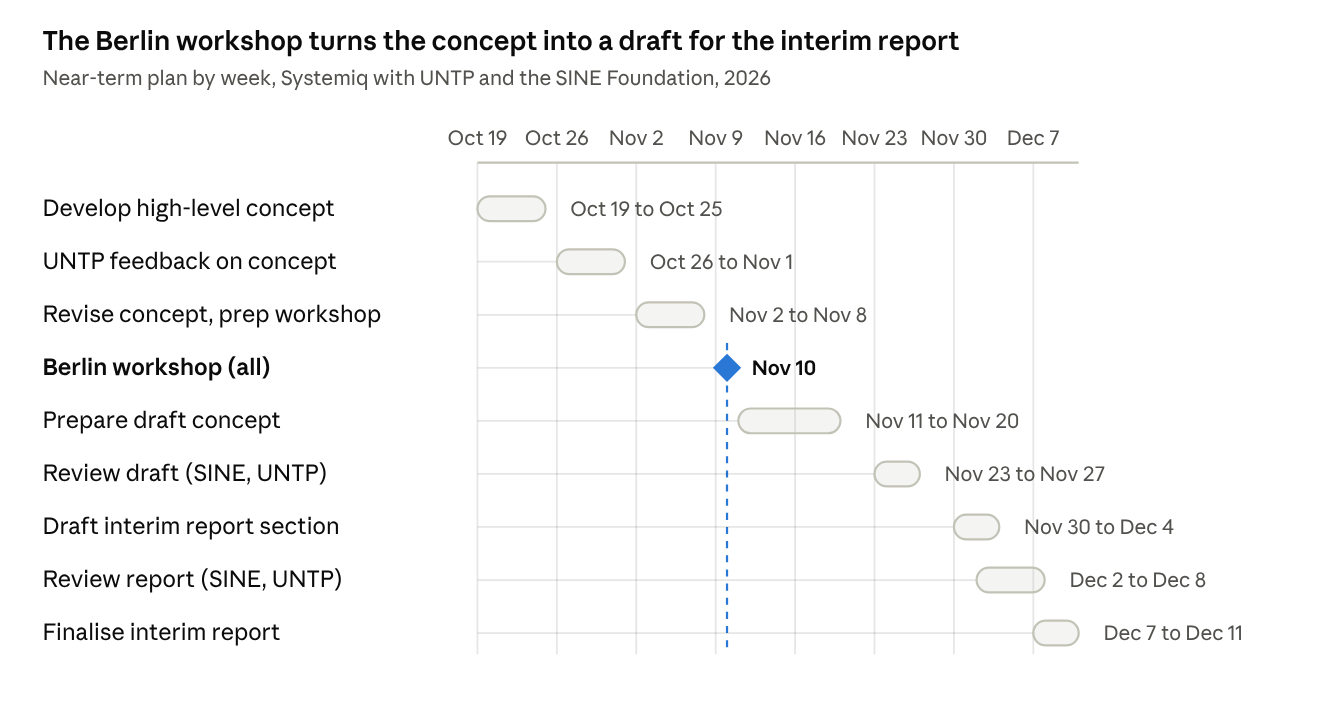
Feedback on initial concept note and preparation for workshop
Berlin workshop with UNTP and the SINE Foundation on 10 November 2026
High-level concept to be included in the GMDH interim report in mid-December 2026
If the proposal appears viable, potential pilot to be scoped and executed in 2027
2. UNTP and GMDH in brief
UN Transparency Protocol (UNTP)
-
What: UNTP is an open, voluntary interoperability protocol from the UN Economic Commission for Europe (UNECE). It lets traceability platforms, digital product passports and reporting tools exchange verified data in one format.
-
How: Firms issue different types of signed, revocable credentials. By design, data stays with its owner, without any central data repository. The credential types divide into quantities, qualities and periodic aggregations:
-
Digital traceability events: the quantities of material shipped or transformed.
-
Digital product passports: the qualities that make those quantities meaningful, such as concentrate grade and emissions intensity.
-
Digital facility records: periodic aggregations at facility level, including total verified and unverified emissions.
-
Digital conformity credentials: an independent assessment of a claim.
-
-
Uptake: Pilot stage. The Global Battery Alliance battery passport and the Responsible Minerals Initiative already use UNTP infrastructure. A critical raw materials pilot started in January 2025.
-
Next phase: Industry communities to commit to implementation at scale. A planned Swiss not-for-profit foundation would fund the roll-out. Version 1.1 will add privacy-preserving chain of custody accounting, now in design with Google and Microsoft.
Global Materials Data Hub (GMDH)
-
What: GMDH is a proposed public data initiative to help address critical issues in the materials data landscape. It is backed by the UN Environment Programme (UNEP), the International Chamber of Commerce (ICC), the Investor Commission on Mining 2030 and the International Resource Panel (IRP)/Systemiq, with wider support by governments (seven representatives as of November 2026) and guidance from wider industry (ICMM, WBCSD). The working group is conducting a scoping study, with the interim report due in mid-December 2026.
-
Scope: The initial scope starts with energy transition minerals but is ultimately planned to extend to all materials: metals, non-metallic minerals, fossil fuels and biomass. The report will highlight use cases from the copper value chain where sensible.
3. What UNTP solves and what it leaves open
In GMDH scoping interviews, firms across the copper value chain consistently named traceability as their top challenge. OECD (2026), Enhancing Resilience through Traceability, points the same way.
UNTP secures data exchange within a supply chain, but the data is not accessible beyond it.
What UNTP solves
-
Trust: Signed, tamper-evident credentials let a buyer rely on a supplier’s claim.
-
Interoperability: One protocol links many platforms and standards, which cuts the cost of proving compliance.
-
Confidentiality: Data goes only to the trading partners who need it.
What UNTP is building next
Privacy-preserving chain of custody: Each facility maintains a Merkle tree of its inputs and outputs, a cryptographic structure in which every transaction is hashed into a single root value. The facility passes its customer only the hashes that link a shipment to that root. The customer can then confirm that a claim is backed by evidence and that the same material has not been claimed twice, without seeing any commercially sensitive data. UNTP is designing this now with Google and Microsoft, with plans for trials and release as version 1.1. The design is also intended to comply with regulations such as China State Council Decrees No. 834 and No. 835, which treats foreign supply chain mapping and compliance as a potential security risk.
While stronger evidence from participating facilities is needed and welcome, it does not replace the potential GMDH case for verification against top-down metrics or enabling third party queries.
What UNTP leaves open
-
No aggregate view: There is no central store or query function, so the data cannot inform policy, finance or business beyond each individual chain.
-
No system-level check: Chain of custody accounting will stop the same material being claimed twice within a chain. It will not expose small over-claims spread across many separate chains, which only a comparison with total production reveals.
-
No coverage measure: Nobody can say what share of production is verified.
-
Costly assurance: Human auditors are required to check conformity evidence.
-
Unsettled data model: A quantity cannot yet state its basis, such as gross weight or contained metal. This sits in the UNTP version 1.1 backlog.
4. The proposal: adding a reconciliation, query and witnessing layer
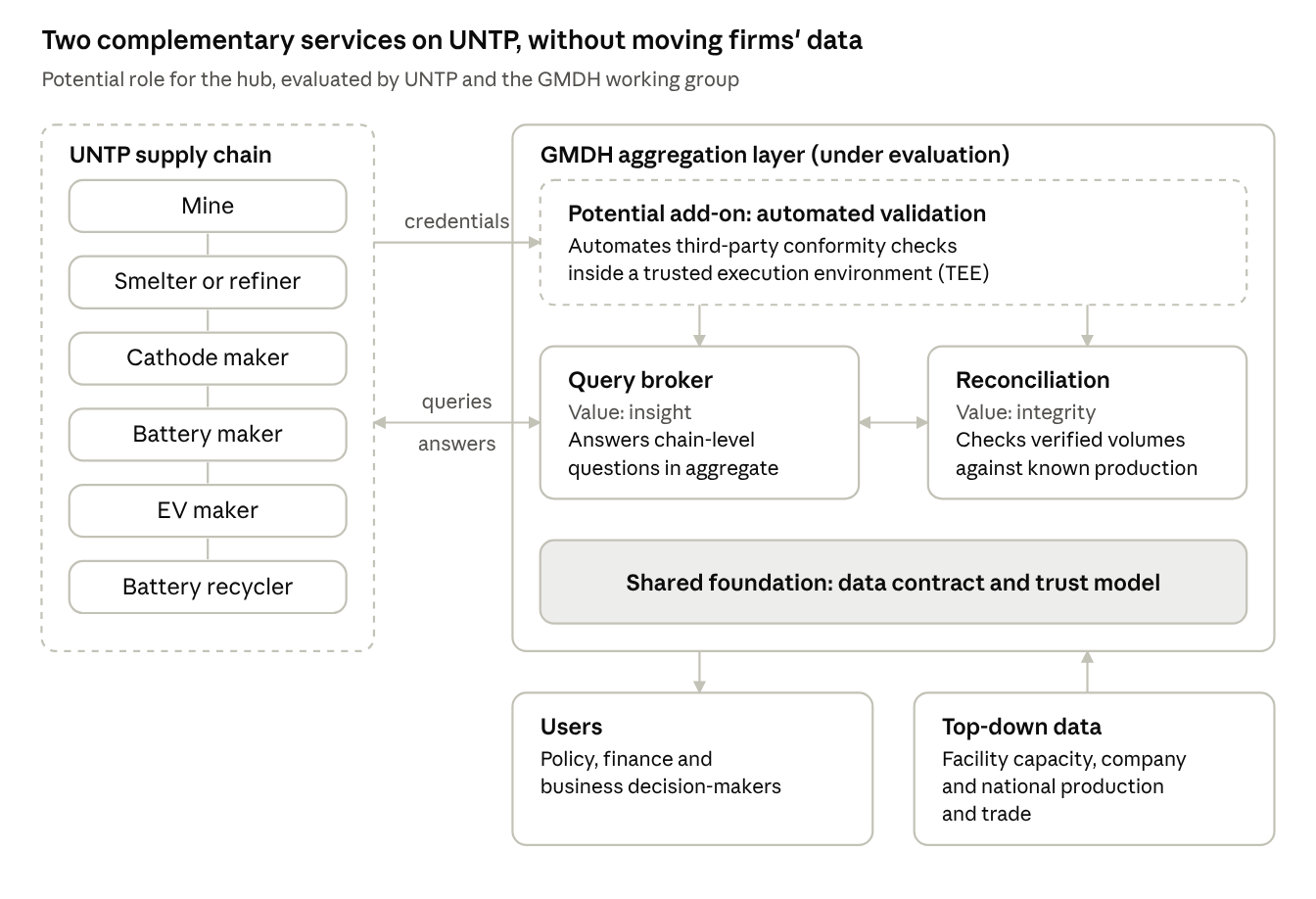
The GMDH working group is evaluating a potential role for the hub: a neutral layer on top of UNTP that turns dispersed credentials into aggregate intelligence, without moving data or exposing any single firm.
 {width=“6.691064085739282in” height=“4.253161636045494in”}
Shared foundation:
Reconciliation and the query broker rely on the same data contract (measurement basis, commodity boundaries, allocation rules) and the same trust model (anonymization thresholds, neutral operator).
Scope: The initiative would cover mass flows and impact attributes together. A quantity such as 100 tons of dry copper concentrate only becomes useful alongside its impact, such as 50 tons of carbon dioxide equivalent derived from verified material intensity assessments and mass balance allocation. Quantities sit in traceability events, qualities in product passports and aggregates in facility records, so any layer above UNTP has to read all three.
-
Reconciliation (integrity): The hub would compare verified bottom-up volumes with facility capacity, company production, and national production and trade figures. This could potentially help detect fraud and triangulate data where sources disagree.
-
Ceiling test: verified volume cannot exceed known production. This exposes over-claiming spread across many facilities.
-
Coverage test: verified volume as a share of known production.
-
-
Query broker (insight): Firms opt in, compute answers locally and return them encrypted. The hub would release only aggregates that clear agreed thresholds, e.g., the greenhouse gas intensity of Chilean copper in electric vehicle (EV) batteries.
-
Blind witness (confidentiality): The hub could sign each facility’s hashed Merkle tree without seeing the private data behind it, so accounts cannot be rewritten after the fact and qualities cannot be double counted. This role can be served by any and ideally multiple trustworthy parties. The initial assumption is that this would not be a major focus or unique proposition for the GMDH.
How the two reinforce each other:
-
Coverage context: Every query answer would carry a coverage figure from reconciliation, so users know how much production it reflects.
-
Plausibility: Reconciliation checks query outputs against known production, which guards against inflated underlying claims.
-
Complementary value: Legitimate producers and buyers gain most from fraud detection, while those seeking a green premium or benchmarking against peers may value queries more highly.
-
Adoption priorities: Reconciliation shows where verified coverage is thinnest, which helps establish reliability and prioritise the push for UNTP adoption.
Where validation sits: Validation happens in several places at once, and UNTP sets out which test belongs where. UNTP itself checks only that implementations conform and interoperate, and sees no data. Facilities validate the credentials they receive from upstream actors. Public data, meaning product passports and facility records, can be validated by anyone holding the product or facility identifier. Private data, such as the volumes in traceability events, is validated by trusted auditors or inside a trusted execution environment (TEE), a secure enclave that runs code without revealing the data. Automating that last step would lower the cost of trusted evidence.
The hub sits in two of these places. It would supply the top-down aggregates that downstream manufacturers and regulators use to test bottom-up claims, and could offer validation as a service on top. It could also act as the blind witness described above.
Hypotheses for GMDH value add (blueprint section)
-
Verified inputs: The hub could label each input as audited, declared or estimated.
-
Honest coverage: The hub could report what share of each material it can verify.
-
New answers: The hub could answer chain-level questions that no single firm or existing data provider can answer.
-
Adoption pull: Aggregate benefits could give firms a reason to join UNTP, rather than being perceived as a new reporting burden.
5. Incentives for firms to opt in
Incentives for adoption are likely a greater barrier than technical feasibility.
Incentive Mechanism Main beneficiaries Key uncertainty
Cheaper trusted evidence Automated checks replace parts of manual audits Upstream producers and processors Will buyers, standard setters and regulators accept automated assurance?
Fraud and origin integrity Detects claims that exceed the material behind them Legitimate producers, buyers and traders How strong is this for fungible bulk materials?
Market access and premium Credible claims support a green premium. OECD (2026) finds over 60% of surveyed firms name brand reputation or customer demand as their main driver Low-carbon and responsible producers Is the premium large and stable enough to pay for adoption?
Compliance support Evidence for due diligence and passport rules, such as the EU Battery Regulation and Critical Raw Materials Act Firms under those rules Would UNTP alone suffice? GMDH adds value where regulators need system-level evidence
Benchmarking Firms compare their performance with an anonymised aggregate Better performers and governments Does benchmarking survive anonymisation thresholds?
The annex sets out potential fraud vectors to test.
Beyond minerals (hypothesis): Batch-level evidence suits metals. Incentives look weak for low-value bulk minerals. Origin rules matter for fossil fuels, and certified biomass already uses mass balance.
6. Timeline and next steps
Concept and feedback (early November)
Workshop (10 November)
Inclusion of concept in interim report (mid-December):
Potential pilot (Q1 2027)
See annex for detailed timeline.
7. Questions for the workshop and beyond
The workshop focuses on two themes: what would make firms opt in, and whether the architecture is technically feasible. Section B outlines issues that we propose to defer for later decision.
A. Workshop focus (10 November)
Incentives: What would firms need for them to choose to opt into the GMDH / UNTP initiative?
-
What fundamental factors would need to be in place for firms to opt into the initiative?
(e.g., anonymisation, security, governance, trusted execution environment, data architecture — leaving technical detail for afternoon)? -
What are the concrete benefits and costs to different firms (e.g., along the copper value chain) and other stakeholders from the initiative, and how significant are they? (e.g., do they stand to gain or lose from transparency)
-
How can the GMDH collaboration best enhance incentives to adopt UNTP?
-
What are examples of existing initiatives that tackle similar problems / fulfil similar functions in other contexts that can be referenced as “proof of concept”?
Technical feasibility
-
What is a viable reference architecture for the two main service lines (reconciliation against top-down data and query broker), and what do they share?
-
What anonymisation thresholds and minimum coverage make query answers both safe and useful in concentrated chains?
-
What could the query / data flow look like in practice, and how would a Trusted Execution Environment Look like?
-
Can a TEE automate conformity validation credibly enough for buyers and assurance bodies to accept it?
-
How should reconciliation sit on top of facility-level chain of custody accounting, and should the hub take the blind witness role?
B. Deferred until after the workshop
Governance: Who operates the layer, its legal home, and links to UNTP’s planned foundation.
Pilot design: Value chains, jurisdictions and success criteria.
Funding: Budgets for the pilot and roll-out.
Beyond minerals: Applicability to non-metallic minerals, fossil fuels and biomass.
Annex
Fraud vectors to test: The closer evidence sits to the batch or item, the more vectors it counters.
Vector Example Relevance to minerals Detection
Mass balance over-claiming Buy 1 tonne certified and 9 tonnes uncertified, then sell 10 tonnes as certified (e.g., organic cotton) High for low-carbon, responsible and recycled-content claims Facility conservation checks and the ceiling test
Origin laundering Illegal or sanctioned-origin ore blended into formal supply High, especially between mine and smelter Reconciling mine output with smelter intake
Relabelling or cloning Fake labels or copied identifiers, as with counterfeit medicines Low for bulk commodities, higher for batteries and components Unique identifiers marked as used once read, as under the EU Falsified Medicines Directive
Undeclared substitution Material never enters any ledger All materials Accounting cannot detect it. It needs physical testing and yield checks
Near-term timeline: Systemiq with UNTP and the SINE Foundation, October to December 2026.
 {width=“6.692913385826771in” height=“3.495851924759405in”}